Sample — a demonstration landing page built by Victory Marketing Solutions from the publicly disclosed North Atlantic Titanium Corp. corporate presentation. Not affiliated with the issuer and not investment advice. Back to Victory →
CSE: NATOOTCQB: NATQF

Corporate presentation · Everett Project

A multi-generational titanium
powerhouse, 3 km from Lac Tio.

Everett is one of the world's most significant hard-rock ilmenite oxide bodies — outcropping, road-accessible, next door to the largest solid ilmenite mine on the planet, and now confirmed by independent labs as exceptionally clean, vanadium-bearing hemo-ilmenite with a phosphate co-product.

  • Titanium
  • High-purity pig iron
  • Vanadium
  • Phosphorus
Flagship
Everett Project, Québec
Historical resource*
234 Mt @ 10.8% TiO₂
Hemo-ilmenite content
48%–50% by weight
Tenure
49 tenures · 2,406 ha
*Historical estimate, not current and not NI 43-101 compliant. See disclosure.

The setting

Three kilometres from the largest hard-rock ilmenite mine on earth.

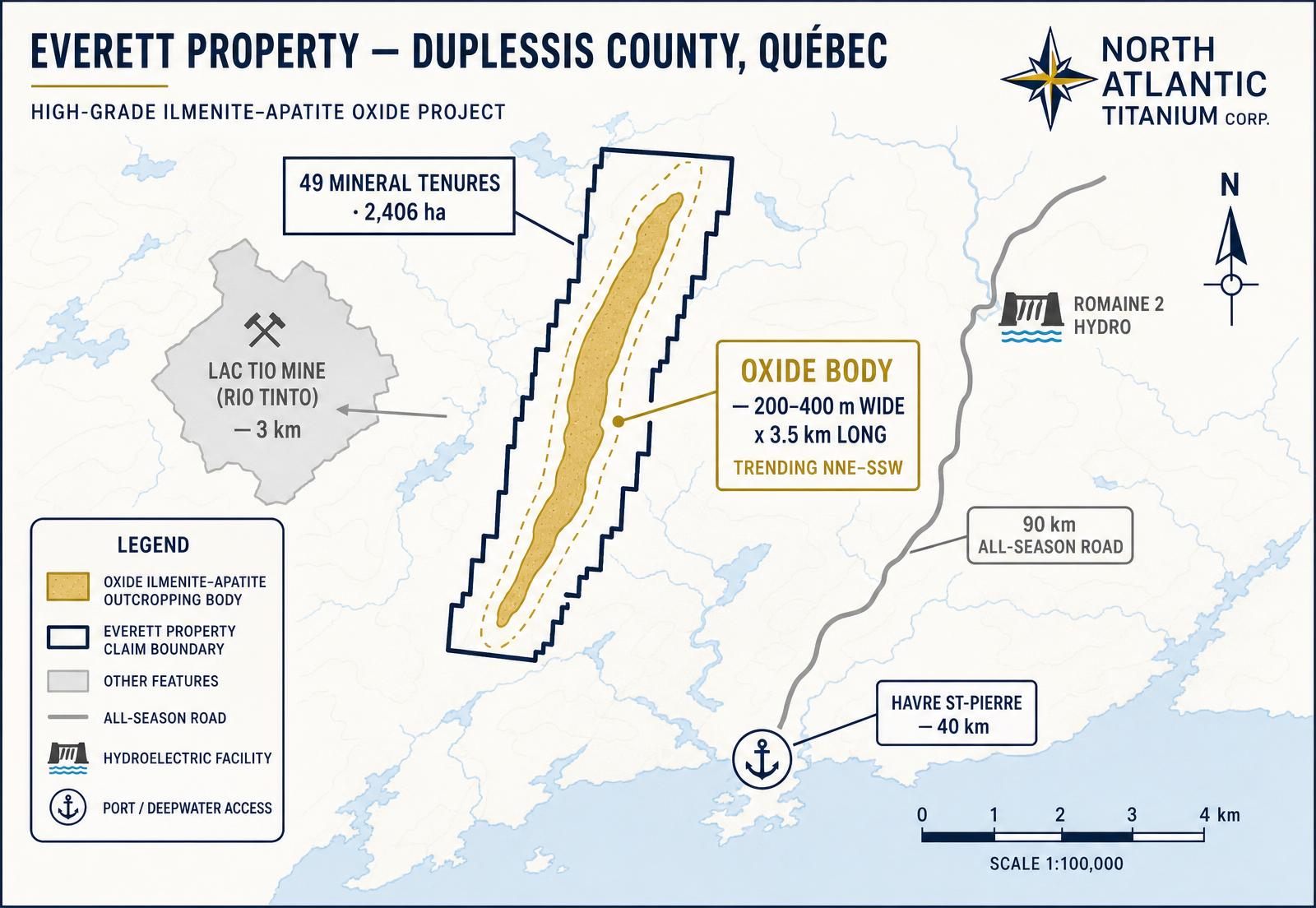
The Everett property sits in Duplessis County, Québec, 3 km east of Rio Tinto's Lac Tio operation — the largest solid ilmenite deposit in the world, supplying roughly 19% of global high-grade titanium dioxide feedstock.[1]

Everett is recognised by the USGS and the Québec Geological Sciences Service as the host of one of the most significant hard-rock ilmenite (FeTiO3) oxide bodies in the world, alongside the producing deposits at Lac Tio, Québec (Rio Tinto Fer et Titane) and Tellnes, Norway (Kronos Worldwide).[1]

LocationDuplessis County, Québec, Canada
Distance to Lac Tio (Rio Tinto)3 km east
Port of Havre St-Pierre40 km
AccessYear-round, 90 km all-season road and highway
PowerProximal to Romaine 2 hydroelectric dam — low-cost
Tenure49 mineral tenures, 2,406 ha (5,946 acres)

The oxide body crops out — semi-massive to massive ilmenite–apatite exposed in an area 200–400 m wide by 3.5 km long, under nothing more than a veneer of thin till and moss.[1]

Location, access and infrastructure

Road, port, power and a neighbour that already ships to market.

Lac Tio production is crushed on site, carried by rail and shipped to Rio Tinto's processing facility in Sorel-Tracy. Everett sits inside that same infrastructure envelope.[1]

Plan map of the Everett property claim block in Duplessis County, Québec, showing the outcropping ilmenite–apatite oxide body, the Lac Tio mine 3 km west, the all-season road to Havre St-Pierre and the Romaine 2 hydroelectric facility
Fig. 1Everett property, claim block and regional infrastructure. Illustrative sample figure — geometry is schematic.
Havre St-Pierre
40 km, port city
Lac Tio (Rio Tinto)
3 km west
Road access
Year-round, 90 km
Power
Romaine 2 hydro, low cost

Want the Phase 2 results when they land? Join the list →

The company

A junior collective built to advance an undervalued critical-minerals asset.

North Atlantic Titanium Corp. is a junior mining exploration company incorporated in British Columbia — a collective of mining professionals dedicated to identifying and nurturing undervalued resource assets with significant upside deposit potential and a relatively low barrier to entry.[1]

The company has signed a definitive option agreement with Romaine River Titanium Inc. to acquire the Everett titanium deposit, and holds a 100% interest in the Sleeping Giant Mine South property in the Val d'Or region of Québec, home to the prolific Abitibi Greenstone Belt.[1]

ListingsCSE: NATO · OTCQB: NATQF · FSE: Y33
FlagshipEverett titanium project, Québec
Second assetSleeping Giant South — 15,000 acres, 100% owned
JurisdictionQuébec — top-ranked mining jurisdiction

Phase 1 metallurgy

The results are in: exceptionally clean ore, with two extra products in the same rock.

On April 29, 2026, independent research labs Corem, the Centre technologique des résidus industriels (CTRI) and Impact Global Solutions (IGS) — in partnership with Elements08 — completed a detailed mineralogical study of rock samples from Everett.[2]

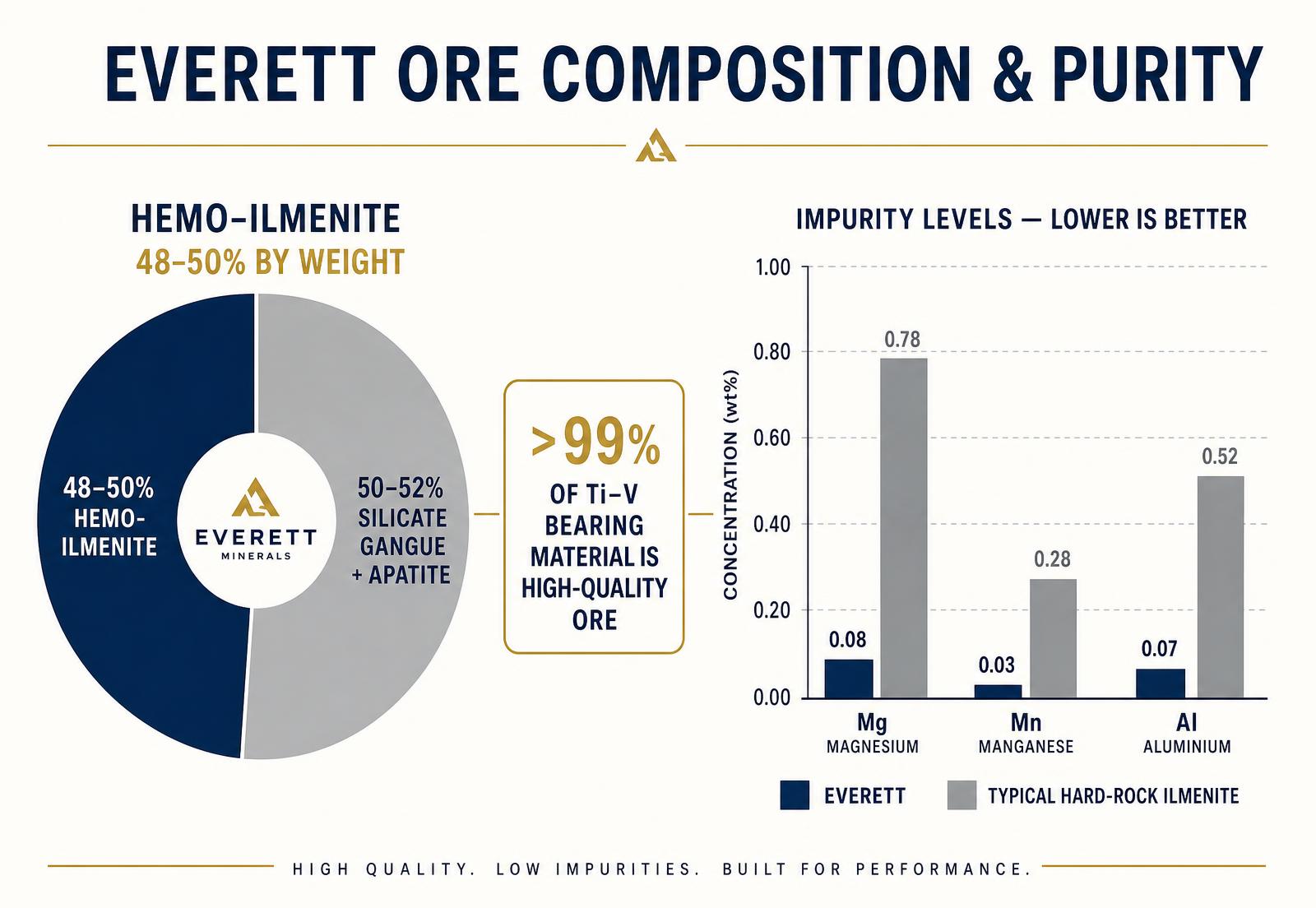
Roughly 48%–50% by weight of the sampled material is hemo-ilmenite, a titanium- and vanadium-bearing mineral. More than 99% of that titanium- and vanadium-bearing material is high-quality ore, with extraordinarily low levels of the impurities that typically cause problems in processing: magnesium, manganese and aluminium.[2]

Hemo-ilmenite content48%–50% by weight
High-quality fraction of Ti–V material> 99%
Key impurities (Mg, Mn, Al)Extraordinarily low
Purity benchmarkCompares favourably with the world's largest hard-rock ilmenite mines

Lower impurities mean lower processing costs, an easier path to a sellable product, and a concentrate that commands higher prices in the titanium market.[2]

How Everett's purity compares

Lower numbers are better. Everett's are low.

Chart showing Everett ore composition as roughly half hemo-ilmenite and a bar chart comparing magnesium, manganese and aluminium impurity levels against typical hard-rock ilmenite
Fig. 2Ore composition and impurity benchmark. Illustrative sample figure based on the Phase 1 mineralogical study.

Why Everett is different

A hemo-ilmenite system — no magnetite to fight through.

Most large-scale ilmenite operations are associated with either anorthosite-hosted deposits (common in Québec and Scandinavia) or titanomagnetite systems, where iron and titanium are tightly locked together. Everett is a hemo-ilmenite system: titanium and vanadium occur together in a single mineral phase, with virtually no magnetite present.[2]

That simplifies the metallurgy considerably — there is no need to separate out an iron-magnetite fraction before recovering titanium and vanadium.

The study also confirmed that most of the very low impurities that do appear at Everett are hosted in the waste rock (silicate gangue) rather than inside the ore mineral itself. The ore mineral is naturally clean, and removing impurities is primarily a matter of separating out the surrounding waste — a proven, well-understood and cost-effective process.[2]

These Corem results are definitive. They confirm that Everett hosts a clean, vanadium-bearing hemo-ilmenite system with favourable metallurgical characteristics. The potential ability to produce a low-impurity titanium concentrate with meaningful vanadium content, alongside a potential phosphate coproduct, represents a compelling pathway for value creation.

Dwayne Yaretz, CEO, North Atlantic Titanium Corp.

Three products from one project

One processing operation, three commercially viable outputs.

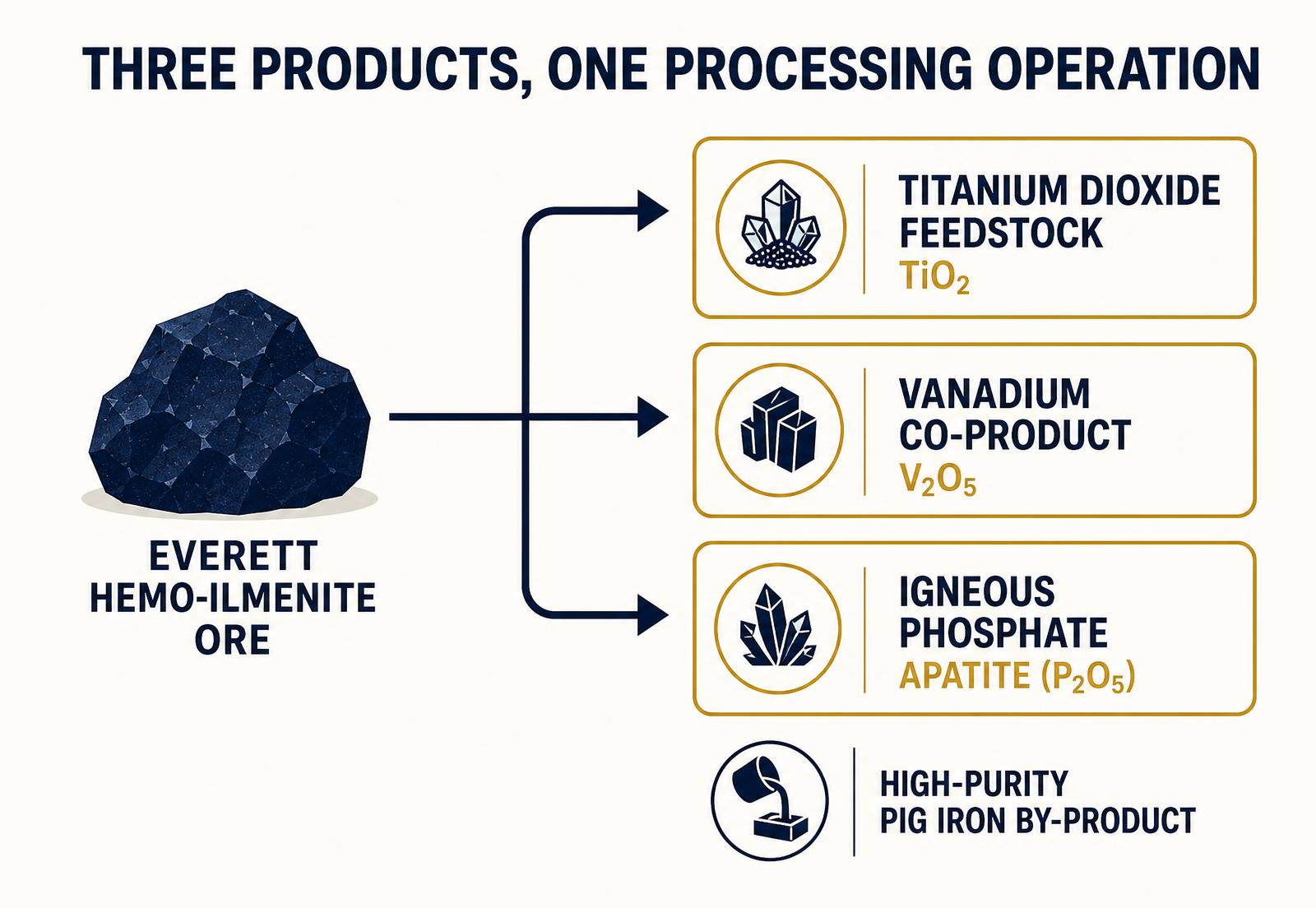
One of the most significant findings of the Phase 1 work is that Everett appears capable of producing three distinct, commercially viable outputs from a single processing operation. That multi-product structure spreads revenue across different markets, reducing exposure to any single commodity price and improving the project's overall economics.[2]

Diagram showing Everett hemo-ilmenite ore branching into titanium dioxide feedstock, a vanadium co-product and an igneous phosphate co-product, with high-purity pig iron as a by-product
Fig. 3Multi-product revenue structure. Illustrative sample figure.
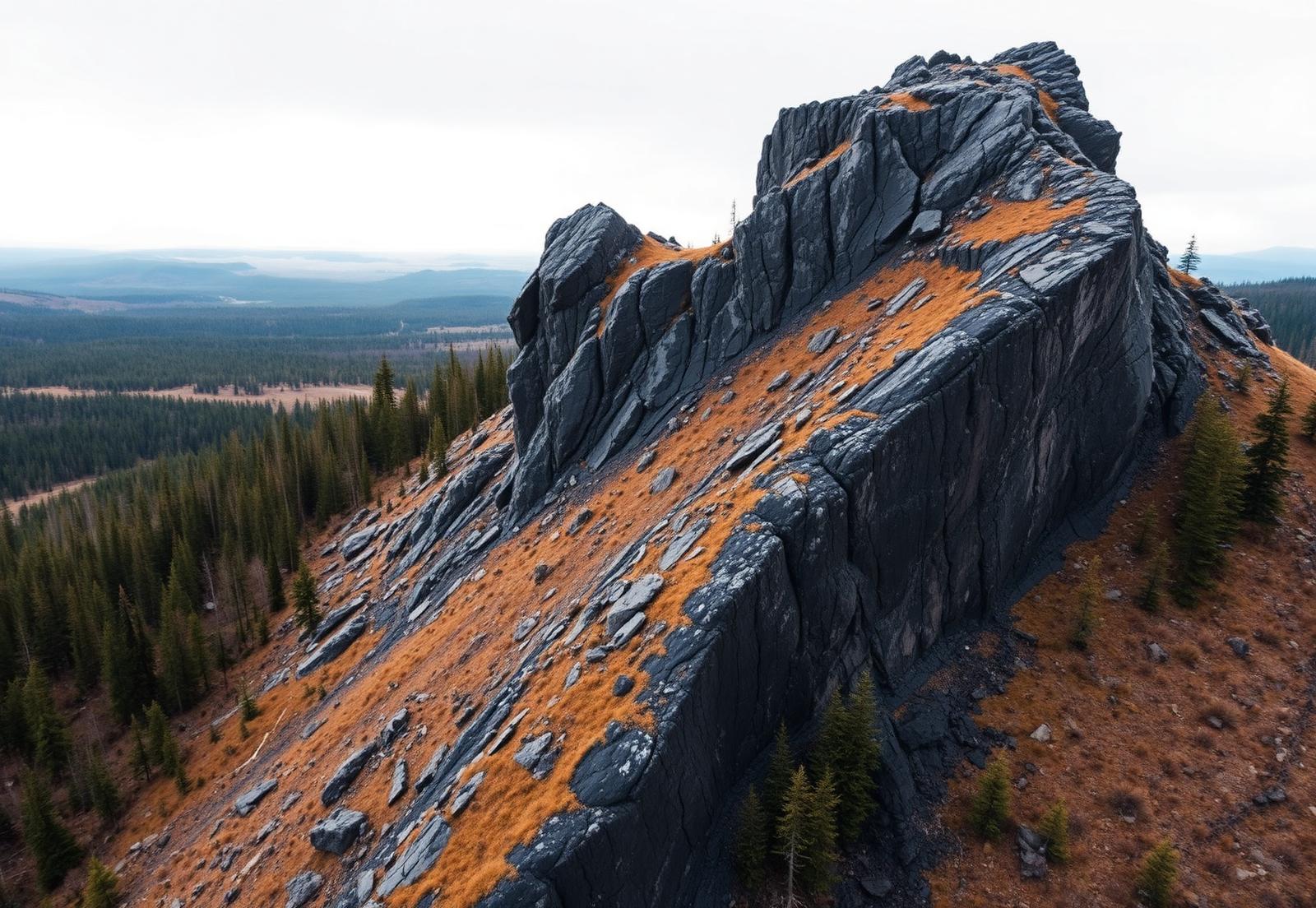
Aerial photograph of a dark oxide outcrop ridge exposed through boreal forest in northern Québec
Fig. 4Outcropping oxide ridge, covered by a veneer of thin till and moss only. Representative sample imagery.

Want the Phase 2 results when they land? Join the list →

The geology

A cumulate igneous layer with an uncommon Fe–Ti–V–P mineralogy.

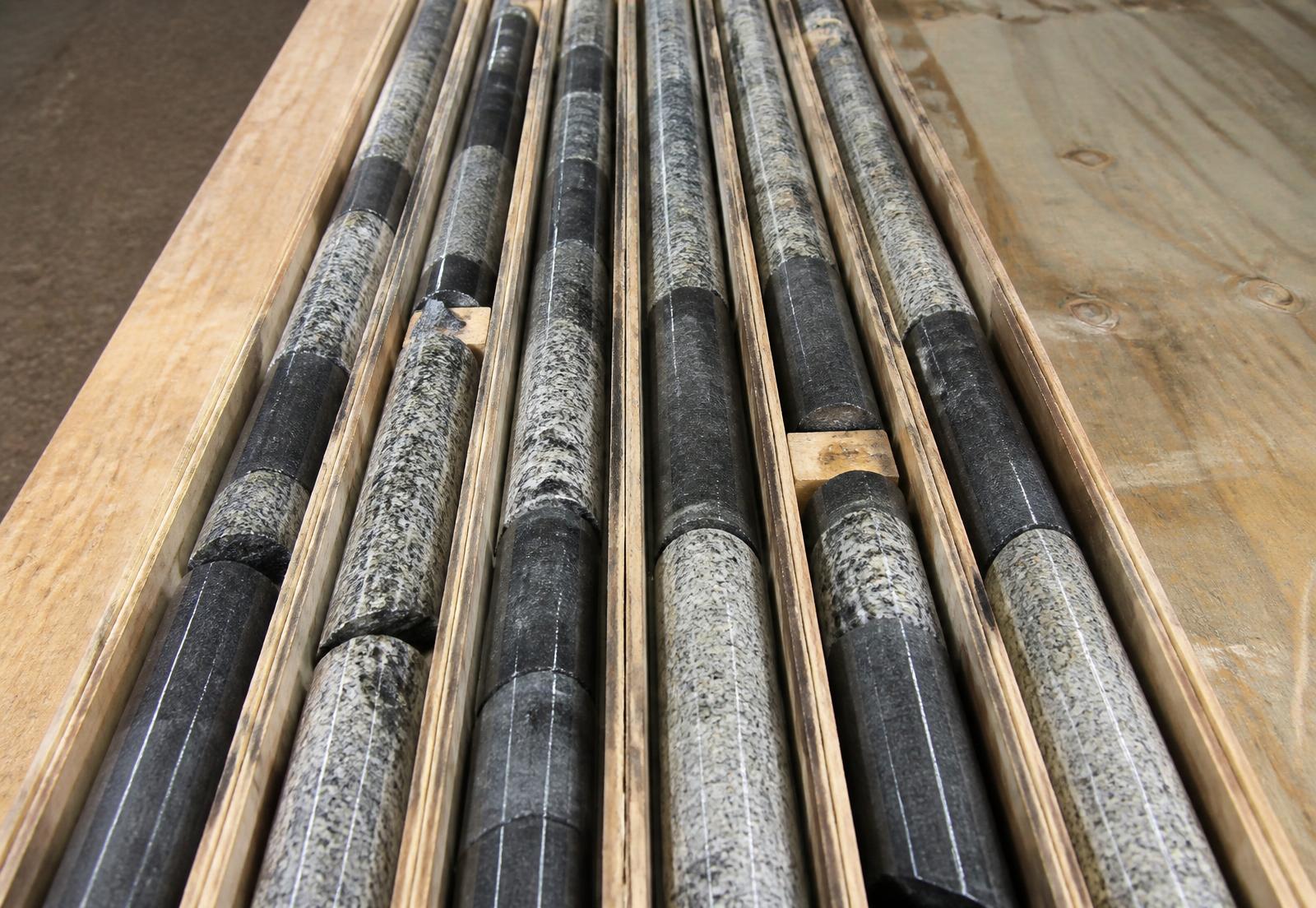
The Everett oxide body is a cumulate igneous layer that dips southeastward and comprises a massive ilmenite–apatite gabbronorite. It forms an NNE–SSW trending ridge, with semi-massive to massive ilmenite–apatite cropping out over an area 200–400 m wide and 3.5 km long.[1]

The body is hosted by a Proterozoic anorthosite–mangerite– charnockite–(rapakivi-)granite (AMCG) suite and is characterised by an uncommon Fe-Ti-V-P mineralogy — the reason a single deposit can carry titanium, vanadium and igneous phosphate together.[1]

In the core

Ilmenite and apatite, in one rock.

Diamond drill core in a wooden core box showing dark semi-massive ilmenite alternating with pale plagioclase-rich gabbronorite
Fig. 5Drill core, semi-massive ilmenite–apatite gabbronorite. Representative sample imagery.
TextureWhat it carries
Massive ilmeniteTi + V, highest grade
Semi-massive ilmeniteTi + V with gangue
Apatite-rich bandsP₂O₅ co-product
Silicate gangueHosts most impurities

Texture descriptions summarise the Phase 1 mineralogical findings.[2]

History

Seventy-five years of work on the same oxide body.

1948 – 1967

  • Everett ilmenite–apatite oxide body discovered by Dr. Everett J. Lees.
  • First work on the property completed with 12 diamond drill holes totalling 4,527 feet.
  • Gulf Titanium (later Romaine River Titanium) completes 18 diamond drill holes totalling 1,500 feet.

1968 – 2003

  • Engineering report completed with historical mineral resource estimate.
  • Historical resource based on shallow drilling only, restricted to the northern portion of the oxide body.
  • 2 bulk samples and 5 significant metallurgical programs conducted — all positive results — plus an engineering scoping study.

2004 – Present

  • Verification work based on 67 sample sites, with 2 drill holes (134 core samples) confirming uniform distribution of grades.
  • Samples averaged 13.7% TiO₂, 22.0% Fe and 3.1% P₂O₅ across the entire oxide body.
  • Locations of certain metallurgical samples, historical drill collars and test pits verified.

Between 1950 and 1968 the oxide body was tested with 34 diamond drill holes and two bulk sample sites, defining a significant historical mineral resource (Lees, 1974). 71 surface sample sites were tested in 2008 to confirm uniform grade distribution (Hurtubise, 2009), and confirmation sampling and surveying were conducted in 2023 (Davy, 2023).[3][5]

Historical resource

234 million tonnes at 10.8% TiO₂ — historical, and stated as such.

The project has 34 drill holes to date, with significant TiO2 intercepts including:[3]

1951 drilling13.04% / 120 m · 11.22% / 120 m · 10.65% / 120 m
1968 drilling15.25% / 32 m · 14.40% / 33 m · 12.45% / 38 m

An engineering report by Lees (1972) cited a historical resource of 234 million tonnes at 10.8% TiO2, 17.9% Fe and 2.8% P2O5, based on both the 1950s and 1968 drilling programs. The 1968 program comprised more definitive drilling and assaying of the northern extremity of the oxide body, defining a separate 340 m strike length — one tenth of the surface oxide exposure length — of 50.8 million tonnes at 14.1% TiO2, 23.3% Fe and 2.8% P2O5 within the larger tonnage reported.[3]

Whole oxide body (historical)234 Mt @ 10.8% TiO₂, 17.9% Fe, 2.8% P₂O₅
Northern 340 m strike (historical)50.8 Mt @ 14.1% TiO₂, 23.3% Fe, 2.8% P₂O₅
Drill holes to date34
SourceLees (1972), GM58981

These "resources" are historical in nature and should not be relied upon, nor treated as a current estimate. It is unlikely they conform to current NI 43-101 requirements or follow CIM Definition Standards, and they have not been verified to determine their relevance or reliability. Originally reported in long tons as 230 million long tons at 10.8% TiO₂, 17.9% Fe and 2.8% P₂O₅, converted here to 234 million metric tonnes at the same grades; the 50 million long tons are similarly converted to 50.8 million tonnes. These historical "resources" are reported without any specific categories, which does not conform to current NI 43-101 requirements, and any comparison is not a valid comparison. A qualified person (QP) has not done sufficient work to classify the estimate as current, and the company is not treating the historical estimate as a current mineral resource. Results are presented for exploration targeting only.

Historical metallurgy

Five programs, five decades, all pointing the same way.

Shawinigan Chemicals Limited (Hart, 1968)

Concentrates were made by standard ore-dressing methods. Ilmenite concentrate could be used to make titanium tetrachloride for the electrolytic process of titanium metal production.

University of Toronto (Alcock, 1973)

Both acid-leaching and high-temperature treatment of Everett mineralized rock samples were able to separate hematite and ilmenite to produce a titanium concentrate.

Québec Dept. of Natural Resources Mineral Research Centre Laboratory (Richard, 1973)

Three tests concluded an ilmenite concentrate could be obtained by crushing to 40% minus 200 mesh (75 microns) and separating ilmenite from the gangue through high-intensity magnetic separation. The process recovered 90.7% of the ilmenite and produced a concentrate grading 32.4% TiO₂.

Lakefield Limited laboratories (Alcock, 1974)

A series of beneficiation studies devised a pyrometallurgical flow sheet that produced pig iron and an upgraded, 80%-pure TiO₂ (slag) concentrate.

University of Toronto (Pedler, 2003) and SGS Lakefield Resources

A combination of magnetic and gravity separation accomplished the best concentration. Grinding to −300 microns produced a 33.4% TiO₂ concentrate at 97.7% recovery; approximately 90% of the phosphate (apatite) could also be recovered.

These metallurgical tests are historical in nature and should not be relied upon, nor treated as current data. It is unlikely they conform to current NI 43-101 requirements or follow CIM Definition Standards. A qualified person (QP) has not done sufficient work to classify the metallurgical tests as current, and the company is not treating these historical tests as current data. Results are presented for exploration targeting only.[4]

The road forward

Phase 1 is complete. Phase 2 is already under way.

Phase 1

Complete
  • Mineralogical characterization — complete.
  • Confirmed ore type, purity levels, mineral associations and liberation behaviour.
  • Established the three-revenue-stream development thesis.

Phase 2

In progress
  • Beneficiation testing — processing the titanium minerals to determine the economic value of the underlying mined ore by separating valuable minerals from waste.
  • Additional results from CTRI and IGS expected soon.
  • Updated NI 43-101 to incorporate metallurgical results and design a sampling and drill program to better define and expand the existing resource estimate.

Phase 2 of the Elements08 program focuses on producing concentrate samples and optimising recovery of all three product streams in a laboratory setting. Additional results from CTRI and IGS are expected soon, alongside an updated NI 43-101 technical report incorporating the metallurgical results and designing a sampling and drill program to better define and expand the existing resource estimate.[2]

Strategic context

The West does not make its own titanium. That is the whole thesis.

Both titanium and vanadium are classified as critical minerals. The Western world currently has very limited domestic production of titanium metal — the vast majority of global titanium supply chain capacity, from mining through metal production, is concentrated in China, Norway, Russia and Ukraine.[2]

North Atlantic Titanium's strategy is to develop Everett as a domestically secure, Canadian source of high-quality titanium sponge feedstock — supporting defence supply chains and the broader reshoring of Western critical minerals processing.[2]

The project benefits from Québec government support through the Elements08 program, which funded and coordinated the metallurgical testing conducted by Corem, CTRI and IGS. The combination of favourable ore chemistry, a clear multi-product processing path and growing policy urgency around critical mineral supply security positions Everett as a project with significant commercial and strategic potential.[2]

Second asset

Sleeping Giant South — 15,000 acres in the Quevillon gold camp.

The property is located on a highly prospective geological unit in the Abitibi Greenstone Belt in the Nord-du-Québec area and hosts major deformation corridors. It has been historically underexplored for base and precious metals, with historical assays returning Cu-Zn-Au-Ag values.[1]

Ownership100% — Sleeping Giant Mine South
ClaimsContiguous, 15,000 acres, Quevillon gold camp
Technical reportNI 43-101 completed Dec. 2020
Proximity500 m south of Abcourt Mines
Sleeping Giant historical production1.1 M oz @ 10.28 g/t Au*
Current M&I reserves (Abcourt)175,757 oz @ 11.2 g/t Au*

*Géant Dormant — Mines Abcourt Inc., NI 43-101, 2019. Figures relate to the adjacent Abcourt property, not to North Atlantic Titanium's claims.[6]

Historical drilling returned visible sulfide mineralization. The presence of a VMS showing and Cu-Zn-Au-Ag mineralization in the vicinity of the property indicates discovery potential. Geochemical targets run west (up to 152 ppm Cu in basalt-andesite assemblages), centre (up to 377 ppm Cu in the same assemblage) and east (up to 10 ppb Au, 131 ppm Cu and 201 ppm Zn in gabbro, felsic tuff and basalt-andesite assemblages).[1]

A low-altitude, high-resolution MAG survey has been completed over the entire property using tight line spacing — a configuration that has seen considerable success with neighbouring companies in the district. Total survey length was 1,620 line-km, and it will help define the numerous geophysical targets on the property for follow-up.[1]

The team

A junior mining collective, run by people who have done it before.

Dwayne Yaretz

CEO & Director

A seasoned entrepreneur with more than 35 years of experience in corporate leadership. He began his international career as Vice-President of China Power Generation Corporation and Asla Power Engineering Corporation, developing co-generation facilities in Mainland China. He has since acted for several publicly traded companies as President and CEO, Corporate Secretary and Chief Financial Officer, and is experienced in mergers and acquisitions and in financing numerous private and public ventures. He has structured both initial public offerings and reverse takeovers across technology, manufacturing and multiple mining exploration projects with properties in China, the United States, Chile and Canada, and has served on boards in technology, clean-tech, agri-business, sustainable packaging, consumer electronics and mining exploration.

Zara Kanji, CPA, CGA

CFO

Founder of Zara Kanji & Associates, CPA (est. 2004), with over 20 years of experience providing financial reporting compliance services to junior listed companies, as well as taxation, general accounting and advisory services to individuals and private and public companies. She has served as a director and officer of listed issuers and has been involved in reporting compliance related to financings and acquisition transactions. She has been a member of the Chartered Professional Accountants of British Columbia and Canada (formerly the Certified General Accountants Association) since August 2003.

Anthony Tam, BSc.Eng

Director

Holds a Bachelor of Science in Engineering Physics and a Bachelor of Science in Mining Engineering, both from Queen's University. He brings over 35 years of experience in the mining industry, including numerous management positions in North America and China.

Respectfully

The Everett property sits on the traditional territory of the Innu Nation.

North Atlantic Titanium Corp. acknowledges that its Everett Property is located within the traditional territory of the Innu Nation, including the Innu community of Ekuanitshit, and recognises and respects the enduring relationship the Innu have with these lands, waters and resources. As activities commence in the region, the company is committed to building a respectful, transparent and long-term relationship with Indigenous communities based on mutual trust, collaboration and shared benefit.[1]

  • Support meaningful participation in project planning and development
  • Promote employment, training and business opportunities
  • Work collaboratively on environmental protection and monitoring
  • Respect cultural values, traditional knowledge and land use
  • Ensure ongoing dialogue throughout the life of the project

The approach is grounded in the principles of reconciliation; free, prior and informed consultation; and responsible resource development — on the belief that sustainable mining can only be achieved through genuine partnership with Indigenous peoples.[1]

Questions

What investors ask us first.

That roughly 48%–50% by weight of the sampled material is hemo-ilmenite, and that more than 99% of the titanium- and vanadium-bearing material is high-quality ore with extraordinarily low magnesium, manganese and aluminium. Lower impurities mean lower processing costs and a concentrate that commands higher prices.

The list

Project milestones go to the list before they go anywhere else.

Phase 2 beneficiation results, the updated NI 43-101, drill program design and corporate developments. No third-party promotions. Unsubscribe any time.

Demonstration page built by Victory Marketing Solutions from public disclosure. Not investment advice.

Sources and disclosure

  1. [1]North Atlantic Titanium Corp., corporate presentation and Everett Property disclosure, natitanium.com (2026).
  2. [2]Phase 1 metallurgical / mineralogical study completed by Corem, Centre technologique des résidus industriels (CTRI) and Impact Global Solutions (IGS), in partnership with Elements08; results released April 29, 2026.
  3. [3]Lees, J. Everett, 1972 — Engineering Report on Gulf Titanium Ltd., GM58981. Historical estimate; not current, not NI 43-101 compliant.
  4. [4]Historical metallurgical programs: Hart (1968), Alcock (1973, 1974), Richard (1973), Pedler (2003) / SGS Lakefield. Historical in nature; presented for exploration targeting only.
  5. [5]Hurtubise (2009) surface sampling; Davy (2023) confirmation sampling and surveying.
  6. [6]Géant Dormant — Mines Abcourt Inc., NI 43-101 technical report (2019), for the adjacent Sleeping Giant Mine.

Every claim on a Victory landing page is traced to a filing, technical report or named source. This page is a demonstration built from publicly available North Atlantic Titanium Corp. disclosure; it is not issued or approved by the company, contains no offer of securities and is not investment advice. Historical resources and historical metallurgical results referenced above are not current, are unlikely to conform to NI 43-101 or CIM Definition Standards, and are presented for exploration targeting only.